
Worst weather: Part 1
One of the most common questions I get asked when telling people about this sailing lifestyle is what is the worst weather that I have ever encountered. Surprisingly, this is a very difficult question for me to answer. To start off, I don’t feel like I have ever been caught in weather bad enough to truly be frightened. I have had bad experiences, I have been anxious, but I have never been in a situation which was genuinely terrifying. Additionally, every weather event is unique with different circumstances that make it severe. For example, passing the New Jersey Coast had lightning, rounding Cape Cod had huge waves, going up the Nova Scotian Coast had dense fog, crossing the Chesapeake Bay had steep waves on a small period, and sailing through Woods Hole had crazy currents.
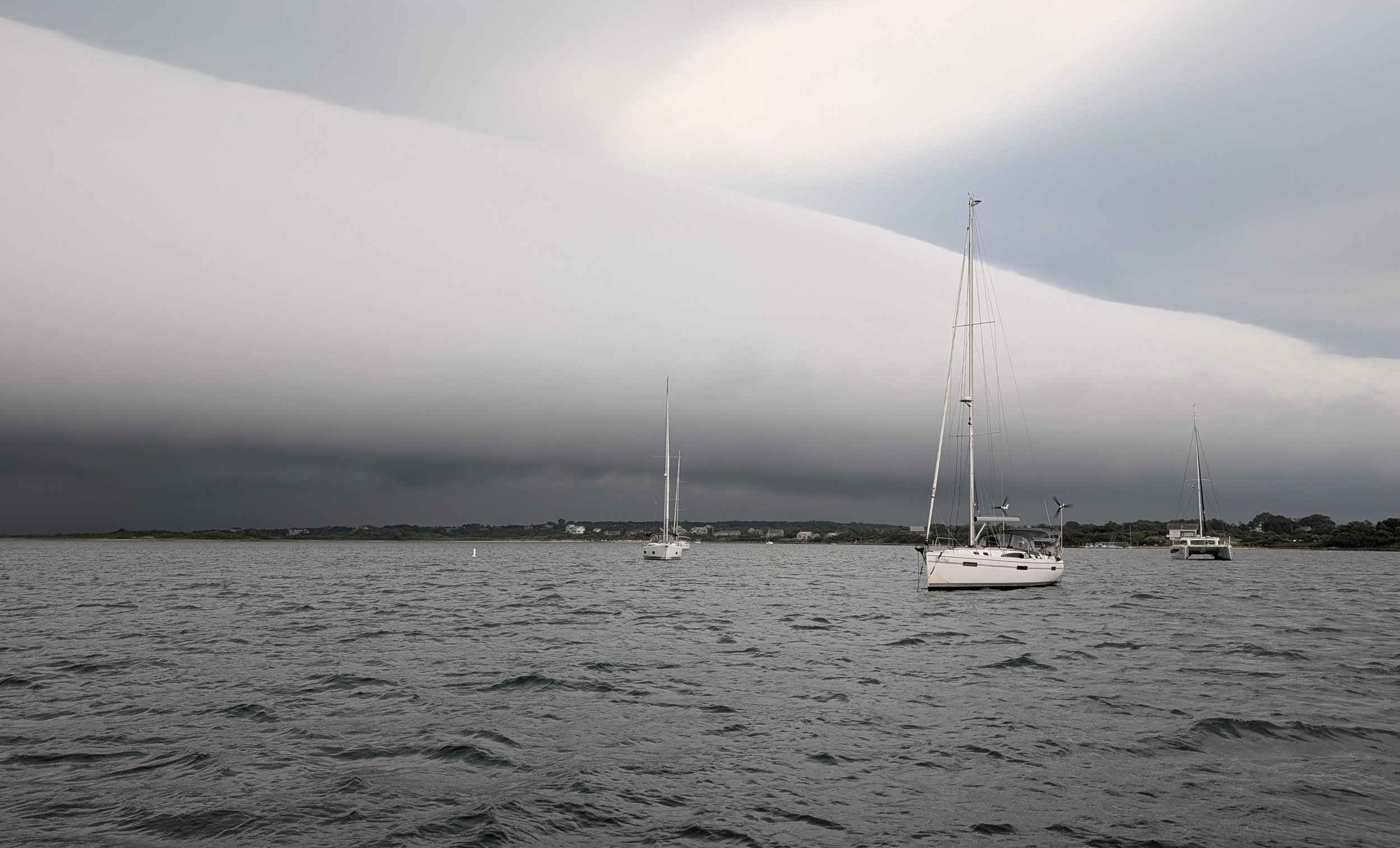
Rolling Cloud Storm Cell in Rhode Island
You’ll notice that none of those examples mention being stuck in a crazy wind. This isn’t to say we haven’t been in gale force winds, we have seen 50+ knots of wind a handful of times. However as I think back on all those windy experiences, we were always able to reduce sail area and the wind no longer was the biggest weather obstacle. I think this revelation always shocks people, as we live on sailboats and thus wind should be the biggest hurtle. I am sure our day is out there where the wind will be so strong that I look back at writing this and think how naive I was. As that day is yet to come, let's get into some of the aforementioned weather events!
Lightning off the Jersey Coast
When we first set off for our summer cruise last July, we picked a weather window that had fairly light winds throughout the ~60 hours we expected to be out to sea. This was deliberate as we had never done an overnight passage before and had sailed less miles on Salty Foxx cumulatively than the amount we expected to sail on this one passage. The first 24 hours were easy as we worked our way up the Delmarva Peninsula, with a significant portion spent motoring through glassy waters. As we spent most of the passage approximately 20 miles off the coast, we did not have cell service and were reliant on the forecast from when we left Hampton. We did have a Garmin InReach and Starlink which both can be set up to receive forecasts when offshore but we naively didn’t feel the need to use them as everything had been more or less as forecasted so far. On the evening of the second night, I awoke to the sky being periodically lit up by lightning.
As I gathered my thoughts, I noted that we were moving along nicely under sail with a pretty normal level of heel and that the sea state was fairly calm. As it was almost midnight, and time for my shift, I got out of bed, got dressed, and met Abby in the cockpit to get a debriefing on what happened during her shift. The first thing I noticed when I emerged from the cabin into the cockpit was how dark the skies were. The previous night, the stars and moon had been so bright, yet here we were, 24 hours later, in udder darkness. Abby informed me that she had begun seeing lightning in the clouds about 2 hours prior, but no strikes were visibly hitting the ocean and there hadn’t been a change in wind speed, wind direction, or sea state. We finished discussing conditions and decided to put all of our important electronics in the oven. This included our handheld VHF radio, one of our cellphones, and the Garmin InReach. We did this because your boat's oven acts as a faraday cage in the case of a lightning strike, which should protect the electronics inside from the EMP effect that comes with being struck by lightning. What I didn’t realize, is that this would stop our Garmin InReach from sending out our position to any family or friends that were keeping track of us. Heading into a storm and then unexpectedly losing GPS position data was not a great look and probably something I won’t ever live down (Sorry John). With that, Abby headed to bed and I put on my foul weather gear, nervous for what was to come.
As I sat in the cockpit, I started to be able to gauge the direction the clouds were moving every time the lightning lit up the sky. While it was darker behind us than ahead of us, the clouds were generally moving across us. It appeared as if we were going to get smacked with a huge dark cloud mass at a little after 1AM. Sure enough, at 0115, the storm clouds opened up and dumped the most obscene amount of water. The oddest thing about this was that the wind and the sea state remained relatively unchanged. I was expecting this dark cloud mass to bring strong gusts and sharp choppy waves. Instead the wind speed only picked up a few knots and stayed steady at 12-15 knots all while the sea state remained fairly calm. As I took shelter under the dodger, I almost couldn’t believe my eyes. We were zipping along at hull speed in the middle of this massive thunder strom but the boat felt oddly calm. I was nervous that at any moment, the wind would increase rapidly and we would get overpowered, but as 10 minutes turned into 30 minutes, the conditions stayed stagnant. The lightning was staying contained in the clouds which was good as taking a direct lightning strike is one of the things that terrifies me the most.
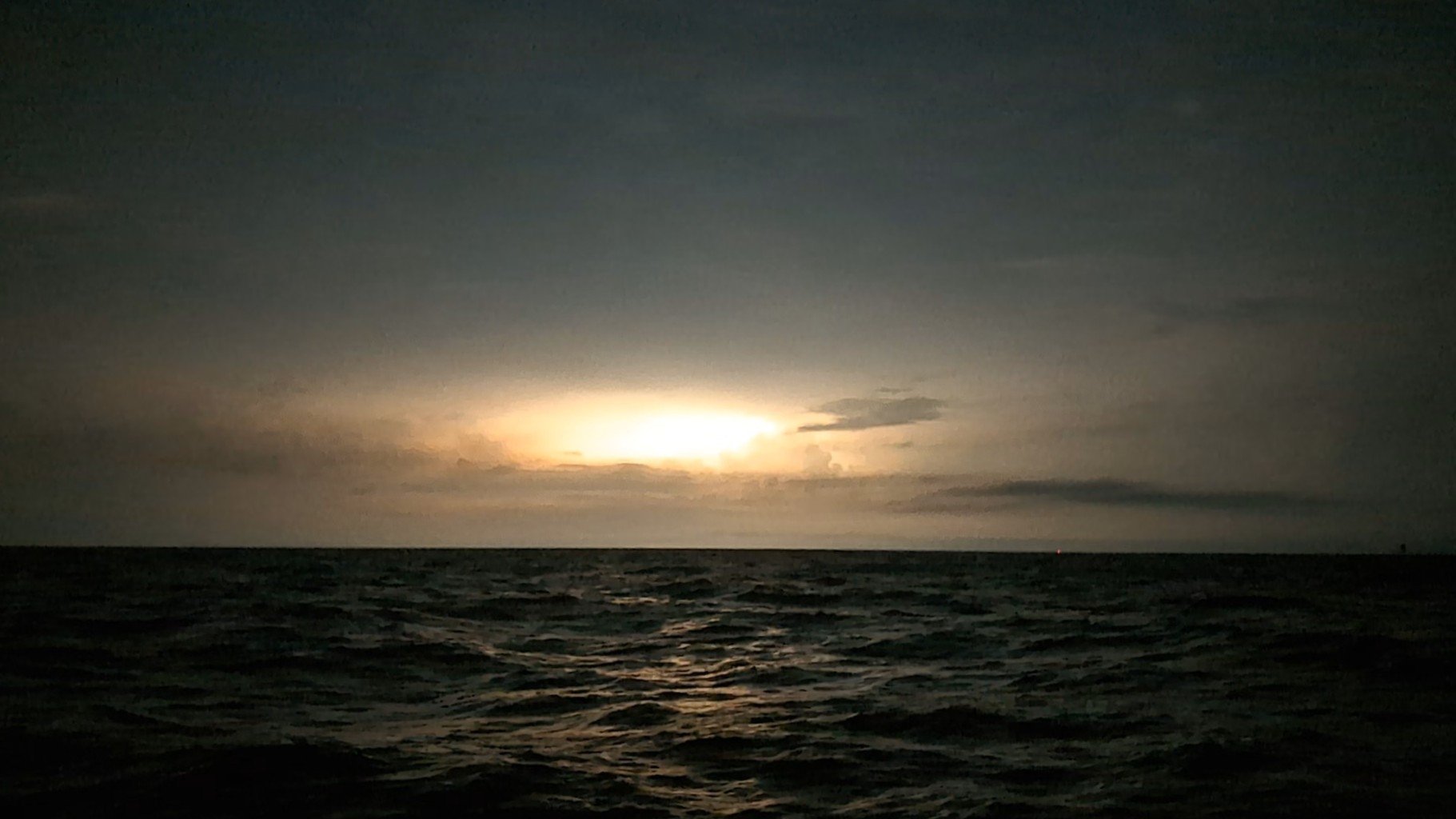
Lightning in the clouds! Believe it or not, it was pitch black the moment before and moment after this picture was taken.
After just under an hour, the rain subsided and the stars began to slowly return. Even though the rain had stopped, the lightning was still keeping me on edge. It continued to light up the sky all around me until I saw two back to back direct strikes on the ocean approximately 5 miles off the port bow. This was the most nervous I had been all night. I adjusted our heading to aim a little further offshore to give more room from the direction I believed the lightning was coming from. Before I knew it, the skies began to be lit up by the morning sun, the clouds around us dissipated, and the risk of being struck by lightning was gone. I pulled our items out of the oven, and we were back on our way north. I later learned that this very storm caused record flooding in the region of the New Jersey coast we were passing.
Surfing around Cape Cod
After turning around in Maine last summer, we wanted to stop at places we missed in our rush to get north. First off was Vineyard Sound so we could go experience the lore that is Nantucket and Martha's Vineyard. We had two options on how to get to Vineyard Sound; the traditional route of heading back through the Cape Cod Canal before turning east through Woods Hole or going around the outside of Cape Cod through the Monomoy Shoals which are the very shoals that caused the pilgrims to turn north back in 1620. As we had already been through the Cape Cod Canal on the way north, we preferred to round the outside of Cape Cod if the weather looked right. On paper, it looked like a pretty simple rounding - head almost due south from Portland, ME while keeping Cape Cod off to Starboard, and then enter through the marked channel into Vineyard Sound. As the passage is about 160 nautical miles, we were thinking that it would take anywhere from 30 to 35 hours. As we planned the route, we diligently checked the forecasted weather and it seemed that there would be consistent 15-20 knots of wind from the East from Friday morning to Saturday morning. As there was only about 24 hours of wind, we decided to get a head start and leave Portland on Thursday afternoon and spend the night in Saco River, ME. This would reduce the trip on Friday by about 20 nautical miles or 4 hours and thus would give us a better chance to sail the entirety of the journey to Vineyard Sound. As we headed out the Portland channel, we checked the weather again as the forecasts had just updated, and were shocked by what we saw. The updated forecast had consistent wind for the next ~20 hours (until ~noon on Friday), followed by 12 hours of no wind, followed by 12 hours of wind. With the updated forecast, we had to make a choice; continue on to Saco River as we planned and risk having to motor to Vineyard Sound, or go now with a stopover in Provincetown during the period of no wind. After a few minutes of deliberation, we decided to just send it!
The forecast was spot on that night, and we sailed almost all the way to Provincetown before the wind ran out. We decided to forego Provincetown proper and anchor right behind the tip of Cape Cod. We dropped anchor around mid afternoon and waited for the wind to fill back in. As we had just sailed overnight, we were both exhausted and went down to get some rest with our alarms set for midnight.
When the alarm woke me at midnight, I knew something was off as I could feel the boat yawing at anchor. The wind had already arrived in a big way. We were forecasted to have 20 knots starting at 0100 with wind slowing through the night to 10 knots by noon. It was just after midnight and we already had 25 knots of wind! Even though the wind was earlier and heavier than expected, we had been in wind stronger than this many times before and decided to go as planned. The wind did create one more issue though; there are strong currents at the tip of Cape Cod which would be directly against the wind. When we had initially planned to leave a little after midnight, the idea was to be through the currents before the wind arrived. Instead we had to fight our way through this extremely uncomfortable and sharp sea state where it felt like we were being hit by waves in every direction. It definitely didn’t help that it was pitch black outside with almost no moon and thus it was extremely difficult to see and prepare ourselves for the next wave. It took almost two hours to make it the 5 nautical miles to the point where we were clear of the Cape Cod currents. Alas, we had made it through that terrible stretch and hoped for a comfortable sail down around Cape Cod.
Nope! As soon as we were through the currents, we entered the ocean swell. Even though we couldn’t see it, it was immediately clear from the motion of the boat that this was the biggest sea state we had ever been in. The only option was forward as we didn’t want to go back through the washing machine of the currents against wind again. As we continued to head on, I could feel the sea state building and building. As we rounded Cape Cod, the waves went from off the port bow to the port beam, and finally settled off the port quarter (mostly behind us). This change in direction increases the apparent wave period as your speed is now going with the waves rather than against them, making the waves pass us every ~10 seconds rather than every ~5 seconds. This change was huge and even though the waves were still building in height, the ride felt much more comfortable. At this point, I furled the main sail and reefed the genoa. The boat felt good, and we were making good headway as we surfed down the waves. It was a little terrifying feeling the boat catch a wave and speed up to over 10 knots, but after every wave, we would slow right back down and wait 10 seconds for the next one. I don’t know if surfing a 20,000 pound boat was on my bucket list, but it sure was an experience I will never forget.
As I started to get comfortable with the motion of the boat in these huge waves, I all of the sudden heard the thundering crash of a breaking wave and was instantaneously soaking wet. A wave had broken over the back of the boat and swamped the cockpit. This was shocking as we have about 4 feet of freeboard to our cockpit and I didn’t even realize this was a possibility (naive me). I scrambled to put the washboards in to seal the cabin from the cockpit and turned on the spot light. Generally, I dislike using the spotlight at night as it ruins my night vision but this was definitely a case where I was glad that I had it. I shined the light off the back of the boat where I could now see these white walls of terror heading towards the boat. I quickly realized how blissfully ignorant I had been for the last few hours. I felt the sea state building, but because the boat felt well balanced, and the helm felt light, I hadn’t bothered to turn on the spot light to see what these waves actually looked like. At this moment I missed that blissful ignorance as I debated what to do. I had read Larry and Lin Pardey’s book, Storm Tactics, so I knew that I could hove to and use the wash of the boat to break down the waves or I could make an improvised drogue out of my fenders and spare chain. Hoving to would essentially stop the boat dead in the water and was designed to be used when waiting out a storm in the open ocean. The improvised drogue would slow the boat down and reduce the speed gained when the boat would start to surf. As I considered my options, another wave broke over the back of Salty Foxx and the cockpit was once again full of water. Even though we had taken these 2 waves, the boat still felt good, and the wind and waves were forecasted to abate when the sun would rise in a little over an hour. Additionally, we were only 5 miles off the coast of Cape Cod and it was a lee shore, which made stopping the forward motion of the boat not a super desirable option. After debating my options, I decided to hold course and diligently watch the wind instrument to see if the wind picked up anymore. I also decided to turn off the spotlight as it was only wrecking my night vision and seeing these behemoth waves only made me more nervous. It wasn’t like there was much I could do at this point if I saw that a wave was about to hit us anyway.
Slowly but surely, the wind began to subside and the seas finally felt like they were getting smaller instead of bigger. As the sun rose, my breath was taken away by how big the waves still were. I had seen them with the spotlight, but now seeing them across the whole horizon, I was speechless. As each wave approached, the horizon line would disappear behind this massive wall of water and then we would be lifted over the wall staring down at the holes in the ocean created in between the waves. The craziest thing was that I knew these waves were smaller than they had been a few hours earlier and yet I was still in awe of their size. Soon, Abby arose from the cabin with Tots and was equally as shocked by the sea state we were in. Through it all, the boat still felt incredibly well balanced, sure it would roll like crazy side to side when a wave passed us, but as soon as the waves were off our port quarter, Salty Foxx felt in tune with the ocean beneath us. As the sun rose, we continued to race down these waves. We ended up passing up the Pollock Rip Channel for fear of shifting sands in this monstrous swell. Eventually the wind left us at around noon and we turned into Vineyard Sound through the Great Round Shoal Channel. Once we dropped the anchor in Nantucket, I checked the NOAA Ocean Buoy data, the waves had normally been between 15 and 18 feet at a 7 second period. Holy Shit was I glad we were done with that!
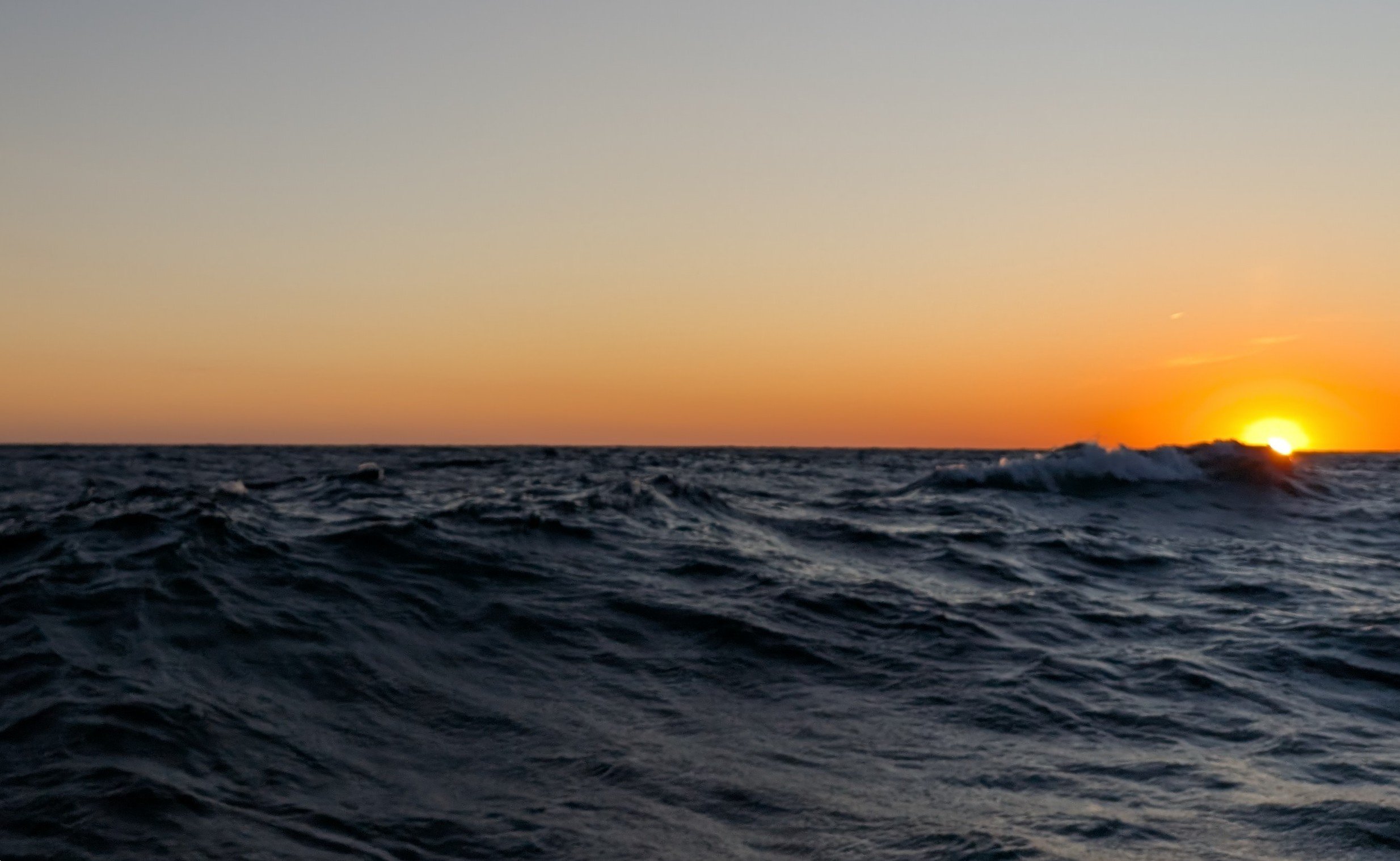
Breaking Waves at Sunrise
